
How to Extend the Blooming Period of Phalaenopsis Orchids: Watering, Light and Placement Tips
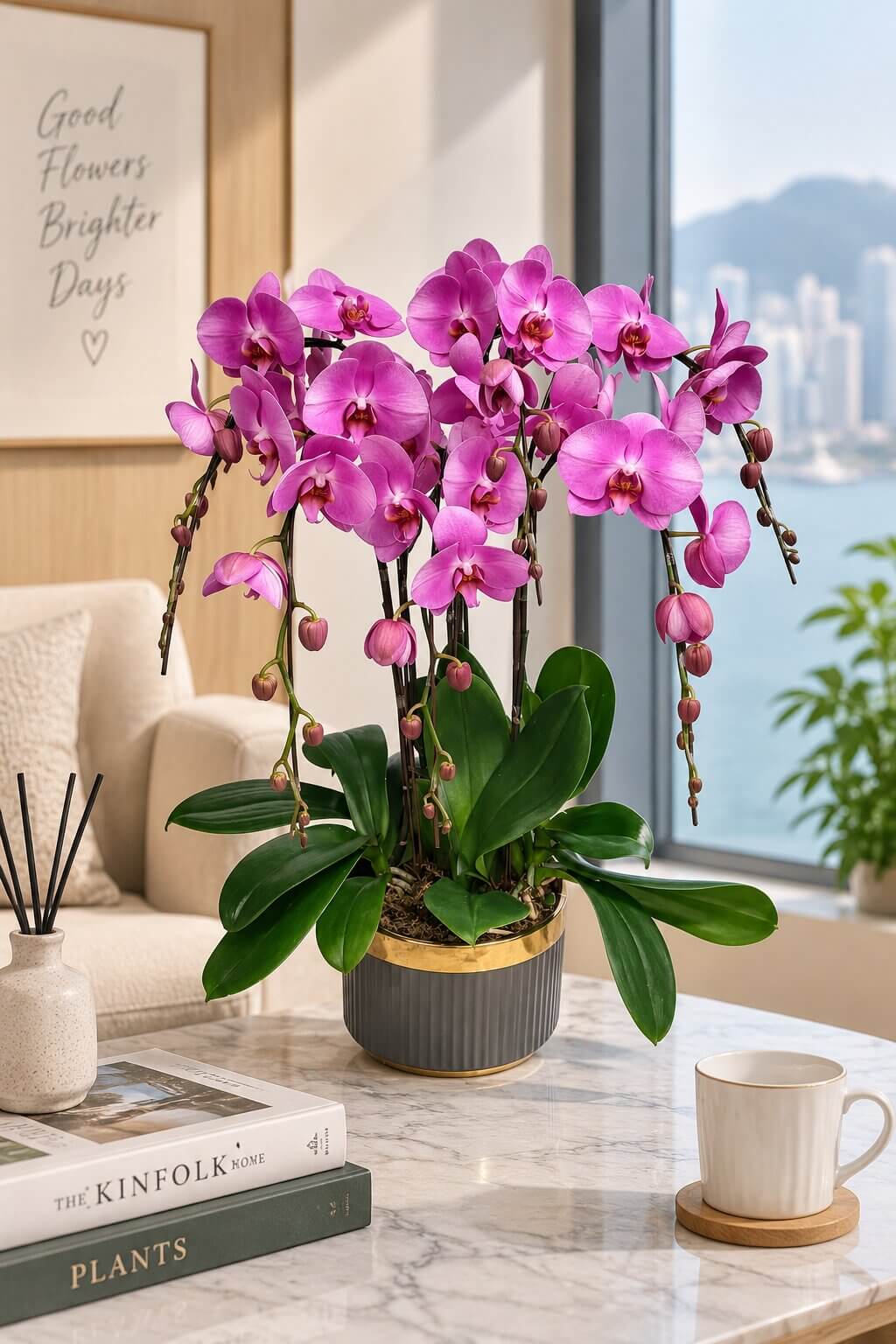
Phalaenopsis orchids, commonly known as moth orchids, are among the most popular indoor flowering plants in Hong Kong. Their elegant appearance and relatively long blooming period make them a popular choice for housewarming gifts, grand openings, Chinese New Year, birthdays and many other celebratory occasions.
One of the most common questions we hear is: How long can a Phalaenopsis orchid stay in bloom?
With a healthy plant, mature buds and the right indoor environment, Phalaenopsis orchids can remain attractive for several weeks. Some well-cared-for orchids may continue flowering for one to two months or even longer.
However, the actual blooming period can vary depending on the variety, how many flowers are already open, indoor temperature, light, humidity and general care.
Why Do Some Phalaenopsis Orchids Bloom for Longer?
One of the characteristics of Phalaenopsis orchids is that the flowers along each spike do not usually open at the same time.
Flowers closer to the base of the spike normally open first, while the buds towards the tip gradually develop and open later.
For this reason, an orchid with a mixture of open flowers and mature unopened buds can often provide a longer overall display. As the earliest flowers naturally begin to fade, new buds may continue opening.
This is why more open flowers do not necessarily mean a better orchid.
An orchid that is already completely in bloom may look particularly impressive on the day it arrives, but there may be fewer new flowers to follow. A plant with a good balance of open flowers and mature buds can often be enjoyed for longer.
Does Hong Kong's Climate Affect Phalaenopsis Orchids?
Yes.
Hong Kong summers are hot and humid, while winters tend to be cooler and drier. On top of this, many homes and offices use air conditioning for long periods, so conditions can vary considerably from one indoor environment to another.
Phalaenopsis orchids generally prefer a warm, bright and well-ventilated environment. However, warmer does not always mean better.
If a room is constantly hot, humid and poorly ventilated, the growing medium may remain wet for too long. This can increase the risk of root problems.
At the other extreme, placing an orchid directly beneath an air-conditioning vent can expose the flowers and leaves to continuous cold, dry airflow, which may cause them to lose moisture more quickly.
For orchids grown indoors in Hong Kong, a stable environment is often more important than constant attention.
Where Should You Place a Phalaenopsis Orchid?
A bright position with plenty of indirect light is generally ideal.
For example, placing the orchid near a window where it receives natural light without prolonged direct sunlight usually works well.
A darker area may be acceptable for a short period, particularly while the orchid is being displayed, but if you intend to keep the plant for a longer time, some natural light is beneficial.
Particular care should be taken with strong afternoon sunlight in Hong Kong.
Although orchids need light, this does not mean they should be placed under intense direct sun for long periods. Strong sunlight can scorch the leaves, causing yellowing, dry patches or permanent damage.
A simple rule to remember is:
Bright light is good. Strong direct sunlight is not.
Can Phalaenopsis Orchids Be Kept in Air-Conditioned Rooms?
Yes, provided they are not placed directly in front of the air-conditioning vent.
Phalaenopsis orchids are frequently displayed in office reception areas, meeting rooms and other air-conditioned spaces. As long as the room is not excessively cold and the plant is not exposed to continuous cold airflow, this is usually not a problem.
If the air conditioning is particularly strong, move the orchid slightly away from the vent.
It is also worth considering what happens after office hours. When the air conditioning is switched off overnight, some offices can become significantly warmer and more humid. If the room also has very little ventilation, the orchid may remain in hot and humid conditions for an extended period.
How Often Should You Water a Phalaenopsis Orchid?
This is one of the areas where problems most commonly occur.
There is no ideal rule such as “water every three days” or “water once a week” that works for every Phalaenopsis orchid.
The amount of water required depends on many factors, including the size of the plant, the type and amount of growing medium, indoor temperature, humidity, air conditioning and ventilation.
A better approach is to check the moisture level of the sphagnum moss or other growing medium before watering.
If the growing medium still feels noticeably damp, there is usually no need to add more water. Wait until it is approaching dryness before watering again.
In fact, many Phalaenopsis orchids suffer more from overwatering than underwatering.
When the roots remain constantly wet, they may not receive enough air and can eventually begin to rot. Once the roots are damaged, adding more water will not solve the problem because the plant may no longer be able to absorb water properly.
Take Extra Care with Decorative Pots
Phalaenopsis orchids given as gifts are often arranged in attractive decorative pots.
These containers are designed primarily for presentation, and some outer pots may not have drainage holes.
This means extra care is needed when watering.
If a large amount of water collects at the bottom of the decorative pot and cannot drain away, the growing medium may remain wet for too long, increasing the risk of root rot.
Do not assume that a large pot requires a large amount of water.
It is better to water moderately and adjust according to the actual moisture level of the growing medium.
Why Are the Orchid Buds Falling Off?
A few fallen buds do not necessarily mean that something is wrong with the orchid.
Phalaenopsis buds can be sensitive to changes in their environment. From the nursery to the florist, and then from the florist to a home or office, the plant may experience several changes in temperature, humidity and light within a short period.
Occasionally, some buds may stop developing or fall naturally as the plant adjusts.
Very small and immature buds can be particularly sensitive and may have a lower chance of opening successfully than larger, more developed buds.
Once your orchid arrives, it is therefore best to choose a suitable location and avoid moving it unnecessarily.
Repeatedly moving an orchid from an air-conditioned room to a hot balcony, or from a bright window during the day to another room at night, can create unnecessary environmental stress.
If Some Flowers Start to Fade, Is the Whole Orchid Dying?
No.
Every orchid flower has a natural lifespan.
The flowers that opened first will usually be the first to fade. If only one or two of the lower flowers are beginning to wilt while the remaining flowers and buds still look healthy, this is usually part of the orchid's normal flowering cycle.
Fully faded flowers can be gently removed to keep the plant looking tidy.
There is no need to heavily prune the entire plant simply because a few flowers have naturally reached the end of their blooming period.
Should You Cut the Flower Spike After the Flowers Have Fallen?
It is usually better to observe the flower spike first.
If the spike remains green, it may still continue growing and, in some cases, may produce another flowering branch.
If the entire flower spike has turned yellow or brown and has completely dried out, the dead section can then be removed.
For people caring for Phalaenopsis orchids for the first time, there is usually no need to rush into pruning. Inappropriate pruning can sometimes cause more problems than simply leaving the plant alone for a little longer.
Do Phalaenopsis Orchids Need Frequent Fertilising?
While the orchid is in bloom, frequent or heavy fertilising is generally unnecessary.
For an orchid being displayed in a home or office, the most important factors are appropriate light, ventilation, watering and a stable environment.
If you intend to keep the plant after flowering and encourage future growth, an orchid fertiliser can be used during the growing period according to the manufacturer's instructions.
More fertiliser does not mean better growth.
Excessively concentrated fertiliser can damage the roots.
How Can You Help Phalaenopsis Orchids Bloom for Longer?
The basic principles are quite simple:
Place the orchid in a bright location without strong direct sunlight, avoid positioning it directly beneath an air-conditioning vent, do not overwater, prevent water from remaining at the bottom of the pot, and avoid moving the plant unnecessarily.
These few steps can prevent many of the most common problems.
When caring for Phalaenopsis orchids, doing less can sometimes be better than doing too much.
It is common for people to worry that they are not caring for their orchid enough and begin watering more frequently, moving the plant around, adding fertiliser or pruning it unnecessarily.
In reality, too much intervention can make it harder for the orchid to adjust to its new environment.
Are Phalaenopsis Orchids Good Gifts?
Yes. One of the major advantages of Phalaenopsis orchids is their elegant appearance combined with a relatively long flowering period.
Compared with a traditional fresh flower bouquet, an orchid arrangement can provide a longer-lasting display, making it particularly suitable for grand openings, housewarming gifts, offices, Chinese New Year and gifts for family members or elders.
However, the recipient's available space should also be considered.
A large, multi-stem orchid arrangement can look impressive but may not be practical in a smaller home. For company reception areas, shop openings or larger offices, a taller arrangement with more flower spikes can create a stronger visual impact.
Choosing the Right Phalaenopsis Orchid
When selecting an orchid, do not judge it only by how many flowers are already open.
Look at the overall condition of the plant, including the flowers, mature buds, leaves and general shape.
An orchid with healthy leaves, good-quality flowers and a mixture of open blooms and mature buds can often provide a longer and more enjoyable display than one in which every flower has already fully opened.
As a natural plant, each Phalaenopsis orchid is also unique. Flower size, colour, shape, direction and stage of blooming may vary slightly from plant to plant and between different batches.
There is no single fixed answer to how long a Phalaenopsis orchid will remain in bloom. Under suitable conditions, however, a healthy orchid can usually provide several weeks of beautiful flowers, with some remaining attractive for considerably longer.
The key to keeping Phalaenopsis orchids in good condition is not complicated: provide plenty of indirect light, avoid strong direct sunlight, water appropriately without allowing the roots to remain constantly wet, keep the plant away from direct air-conditioning airflow, and maintain a reasonably stable environment.
With the right orchid and a few simple care habits, Phalaenopsis orchids are an excellent long-lasting flowering plant for both Hong Kong homes and offices.